Bangkok: A 5-Day Urban Adventure Guide
Bangkok in 2026 is the world's most-booked flight destination and Time Out's top Asian food city. Street food, transit hacks, night markets, DTV visa.
TL;DR
Bangkok is the world’s most-booked flight destination for 2026 and Time Out’s top Asian food city. It rewards travelers who move like locals: eat where the plastic stools are full, ride the BTS with a Rabbit Card, and skip the tuk-tuk tourist traps. This guide covers the transit hacks, street-food rules, night markets, and visa options that make a 5-day trip feel like you actually live here.
Who This Guide Is For
First-time visitors who want to skip the tourist bubble and eat the real food. Digital nomads testing Bangkok as a Southeast Asia base. Budget travelers who want $30 days that feel expensive in experience. Anyone who has heard “Bangkok is chaotic” and wants to know where the chaos ends and the system begins.
This guide assumes you are comfortable with public transit, willing to eat street food, and ready to move through a city of 10 million without a tour group.
Quick Facts
| Question | Answer |
|---|---|
| Best time to go | November–February (cool, dry season) |
| Typical duration | 3–5 days |
| Difficulty | Easy |
| Typical daily budget | $25–$60 USD |
| Core principle | Eat where locals eat, ride what commuters ride, skip the tuk-tuk |
| Best for | Food, urban exploration, digital nomads, budget travel |
Visa: Exemption vs DTV (updated for the 15 Sep 2026 rule change)
Thailand’s 60-day visa exemption (93 countries, July 2024) was repealed in the Royal Gazette of 31 Aug 2026 (Vol. 143, Special 207 Ngor) and replaced, effective 15 Sep 2026, with a shorter scheme. Here is what that means for a Bangkok trip:
| Your trip | What you get | Source |
|---|---|---|
| Up to 30 days, tourism only | Visa exemption on arrival — 30 days, free. Land-border entries capped at 2 per calendar year (Malaysia, Brunei, Indonesia, Singapore exempt from the cap) | Ministry of Interior announcement, Gazette 31 Aug 2026 |
| Arriving before 15 Sep 2026 | The old 60-day stamp still applies and runs its full course — the repeal does not shorten a stay already granted | PRD / Thai MFA, 4 Sep 2026 |
| 30–60 days | Extend once at any immigration office: form TM.7, 1,900 THB, +30 days (discretionary) | Royal Thai Embassy, Washington DC |
| Long stay / digital nomad | DTV (Destination Thailand Visa): 5-year multi-entry, 180 days per entry, THB 500,000 provable funds. File from outside Thailand only | Thai eVisa portal |
| Business or work | The new exemption is tourism only. The old scheme covered short-term business — that wording is gone. Use a Non-Immigrant B visa | ThaiLawOnline / Newland Chase |
Verify before you book: the 60-country list and the 15-day lane (Mauritius, Seychelles) plus the 3-country Visa on Arrival list (Azerbaijan, Belarus, Serbia) are published by the Ministry of Foreign Affairs and the Tourism Authority of Thailand. If your passport is not on any list, you need a tourist visa or eVisa before you fly.
Before You Go
Checklist
Documents & Money
- Passport with 6+ months validity
- Cash: withdraw 5,000–10,000 THB at airport ATM (SuperRich gives better rates than exchange desks)
- Travel insurance with medical coverage
- Proof of onward travel (immigration sometimes asks)
Visa
- Check current visa exemption rules at Ministry of Foreign Affairs before booking — as of 15 Sep 2026 the exemption is 30 days, tourism only, for 60 nationalities (down from 60 days / 93 countries). Entries before 15 Sep keep the 60-day stamp.
- If staying longer: DTV (Destination Thailand Visa) gives 180 days per entry, 5-year multi-entry, for remote workers — requires THB 500,000 provable funds
- TDAC (Thailand Digital Arrival Card) completed online within 72 hours before landing
Apps to Download
- Google Maps offline for BTS/MRT lines and street-food stalls
- Grab or Bolt for ride-hailing (fixed prices, no haggling)
- Rabbit Card app for BTS balance checks
- Tabelog or Wongnai for restaurant recommendations
Gear
- Comfortable walking shoes (you will hit 12,000+ steps)
- Compact daypack with lockable zippers
- Portable charger
- Reusable water bottle (7-Eleven sells filtered water for 5 THB)
- Light rain jacket (June–October showers are sudden and heavy)
Getting There
Suvarnabhumi Airport (BKK) is the main international gateway. For official airport information, see Suvarnabhumi Airport. Don Taxi counters in the arrivals hall offer fixed-price metered rides to the city. The Airport Rail Link runs every 10 minutes from Phaya Thai to Suvarnabhumi (45 THB), but a taxi or Grab is faster if you have luggage.
| From | To | Time | Cost |
|---|---|---|---|
| Airport → Sukhumvit | Taxi / Grab | 30–60 min | 150–250 THB ($4–7) |
| Airport → Khao San | Airport Bus | 60–90 min | 150 THB ($4) |
| Airport → Phaya Thai | Airport Rail Link | 30 min | 45 THB ($1.25) |
Where to Stay
For first-timers, stay between Nana and Asok on the BTS Sukhumvit Line. You are on the transit line, walking distance to both BTS and MRT, surrounded by restaurants and 7-Eleven on every corner. A hostel dorm runs 200–600 THB ($6–17) per night; a 3-star hotel room is 600–1,200 THB ($17–34).
- Sukhumvit Soi 11 — mid-range hotels, nightlife, BTS right outside.
- Siam area — central, between BTS and MRT, close to the big malls.
- Riverside — quieter and upcale, but further from transit.
Whatever you book, confirm it is within 500m of a BTS or MRT station. The taxi ride from a “cheap” hotel in the wrong neighborhood erases the savings.
What to Eat
Street food starts at 40 THB ($1.15) for pad thai or mango sticky rice. The rule: if a stall has office workers on plastic stools at 11 a.m., that is your quality and price signal.
Thip Samai (3073 Phetchaburi Road) — the original pad thai, 60 THB. Go at 2 p.m. when the lunch rush thins.
Raan Jay Ma (Sukhumvit Soi 38) — boat noodles, 25 THB each. Order three; they are tiny.
Mall food courts — MBK, Siam Paragon, CentralWorld. A full meal runs 60–120 THB under A/C.
Or Tor Kor Market (101 Kamphaeng Phet Road, Chatuchak) — CNN named it one of the world’s 10 best fresh food markets in 2017. Clean, covered, selling seasonal fruit, river prawns, and ready-to-eat curries. Free entry; food costs 30–120 THB. Get there at 10 a.m. for the best selection.
The Markets, Ranked
Chatuchak Weekend Market (Kamphaeng Phet Road) — 15,000 stalls across 35 acres, Saturday–Sunday only. Travelbag named it the world’s most popular night market for 2026. Worth it for vintage clothes, leather goods, and mango sticky rice. Arrive before 11 a.m.; crowds and heat peak after 2 p.m. BTS Mo Chit or MRT Kamphaeng Phet Exit 2.
Talad Rot Fai Srinakarin (Srinakarin Soi 51) — Thursday–Sunday, vintage antiques and container bars. MRT to Suan Luang Rama IX, Exit 1, five-minute walk. Best after 7 p.m.
Jodd Fairs Night Market (Rama IX) — reopened and thriving, with street food 40–200 THB per dish. Grab or MRT to Rama IX.
Transit Hacks
Bangkok’s transit is run by two separate companies with no shared payment standard. The BTS (Skytrain) uses the Rabbit Card — 200 THB deposit plus stored value — while the MRT subway is tapped with contactless Visa/Mastercard directly. Transfer between them means exiting one system and tapping into the other.
Buy the Rabbit Card at any BTS station for 200 THB (100 THB deposit + 100 THB loaded). For BTS routes and schedules, see Bangkok Mass Transit System. Most BTS rides cost 16–59 THB ($0.46–1.77), with a one-day pass at 140 THB. The MRT Blue Line — the one that reaches Chinatown and the Grand Palace — takes tap-to-pay cards.
For Suvarnabhumi Airport, the Airport Rail Link from Phaya Thai costs 45 THB ($1.25) and runs every 10 minutes. The 250 THB airport bus is only worth it if you are heading straight to Khao San Road.
Day-by-Day Itinerary
Day 1: Old Bangkok
Morning: Grand Palace and Wat Phra Kaew. Arrive at 8:30 a.m. before the tour buses. The ticket includes Wat Phra Kaew and is 500 THB.
Afternoon: Wat Pho (Thai massage temple) and Wat Arun across the river. Take the 16 THB river ferry from Tha Tien pier.
Evening: Chinatown (Yaowarat Road) for street food after dark. The lanes behind the main road are where the best crab omelet and oyster omelet stalls operate.
Day 2: Markets and Malls
Morning: Or Tor Kor Market at 10 a.m. for fresh fruit, river prawns, and ready-to-eat curries.
Afternoon: Chatuchak Weekend Market (if Saturday–Sunday) or Siam Paragon / MBK (if weekday). MBK is cheaper and more chaotic; Siam Paragon is polished and family-friendly.
Evening: Jodd Fairs Night Market for street food in a curated, clean environment.
Day 3: Sukhumvit and Street Food
Morning: Thip Samai for pad thai at 2 p.m. Walk it off on Sukhumvit Soi 11, lined with coffee shops and mid-range hotels.
Afternoon: Raan Jay Ma at Sukhumvit Soi 38 for boat noodles. The soi is being redeveloped, so check if the stall has moved before you go.
Evening: Erawan Shrine at Ratchaprasong intersection for a quiet moment in the middle of the city, then Sukhumvit Soi 11 for drinks and people-watching.
Day 4: River and Culture
Morning: River ferry from Saphan Taksin pier downstream past the Grand Palace, Wat Arun, and the riverside hotels. Flat 16 THB token.
Afternoon: ICONSIAM mall on the riverbank. The indoor floating market on the ground floor is touristy but clean and photogenic. The rooftop offers river views.
Evening: Lumphini Park for a sunset jog or watch the monitor lizards roam the lawns. It is safe, green, and surprisingly peaceful in a city of 10 million.
Day 5: Day Trip or Deep Dive
Option A: Ayutthaya by train from Hua Lamphong (1.5 hours, 15–50 THB). The ancient capital is a UNESCO site with temple ruins and Buddha heads in tree roots.
Option B: Chiang Mai if you want to extend. Domestic flights from Don Mueang (DMK) run 30 minutes and cost 800–1,500 THB if booked early.
Option C: Stay in Bangkok and do the Grand Palace properly, then Jim Thompson House for silk history and a quiet garden.
Skip
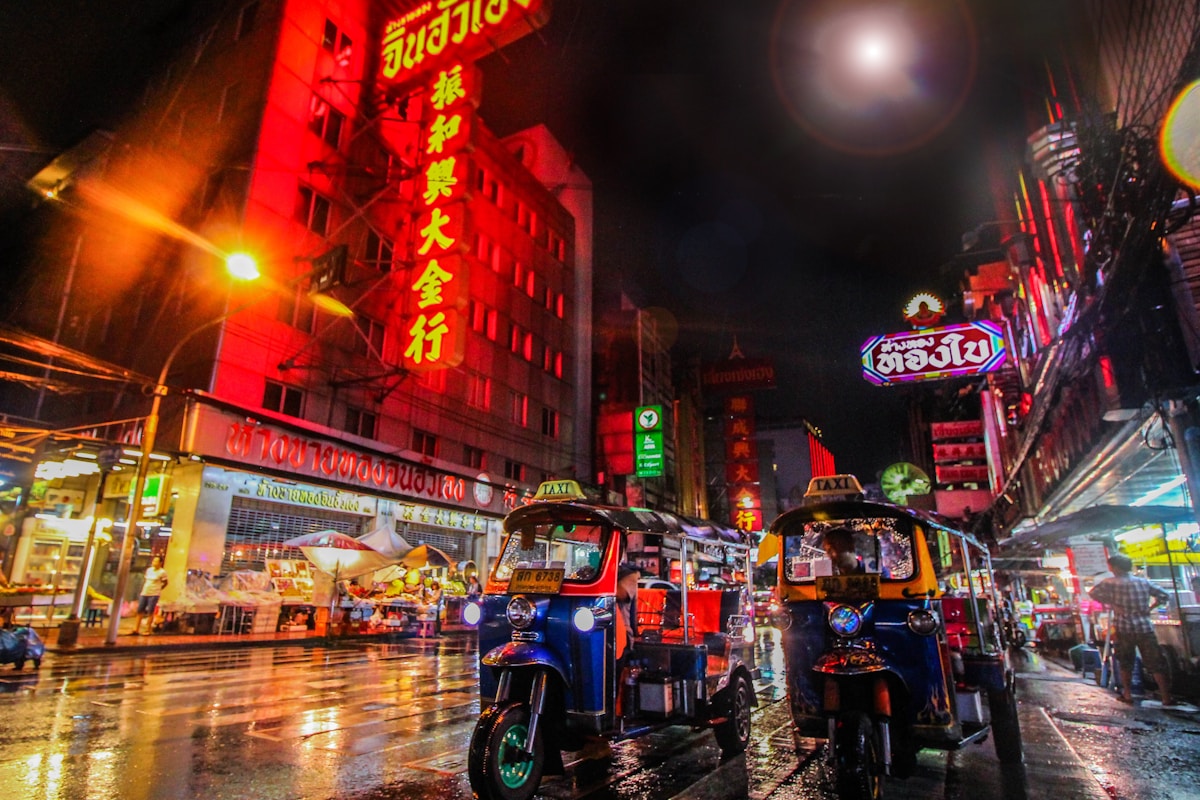
- Tuk-tuks: drivers quote 10x the real fare and crawl through traffic. One for the photo, then switch to Grab or the BTS.
- Khao San Road: it is a backpacker island, not Bangkok. The real city lives six kilometers away.
- “Tourist reserved” boat tours: any canal package pitched near the Grand Palace — buy your own 16 THB river ferry token instead.
- Street food after midnight: the best stalls close by 10 p.m. After that, you pay premium prices for reheated food.
- Mixing up your cards: one Rabbit Card will not work on the MRT, and tap-to-pay does not work on the BTS yet.
What $30 a Day Actually Buys
Backpacker day: hostel dorm near Nana (400 THB), 7-Eleven breakfast (40 THB), pad thai from a cart (50 THB), food court dinner (80 THB), four BTS/MRT rides (80 THB), one free temple (0–100 THB), water and snacks (30 THB) = roughly 680 THB, about $19. The remaining $11 buys a one-hour Thai massage (200 THB).
Bangkok is the rare major city where $30 still buys a full day of genuine local experience — if you pick the right stall.
One Thing You Can’t Skip
A river ferry at sunset. A flat 16 THB token from Saphan Taksin pier takes you downstream past the Grand Palace, Wat Arun, and the riverside hotels. The light hits the temples just right, and you are seeing Bangkok the way it has always been seen — from the water. No tour, no mark-up, just a plastic seat and the city going by. It is the best 30 minutes you will spend here, and it costs less than a beer.
The best trips do not just move you across a map. They change how you see the world. Use this guide to build your own story.
Start Planning Your Story