Brussels: The Complete 2026 Guide to Belgium's Underrated Capital
Brussels in 2026 is having a renaissance: Kanal-Centre Pompidou opens in November, the Atomium turns 20. This guide covers the EU quarter, Comic Strip Route,...
TL;DR
Brussels in 2026 is having a renaissance: Kanal-Centre Pompidou opens in November, the Atomium turns 20 with new digital art installations, and the Grand-Place hosts the Flower Carpet in August. The city rewards travelers who skip the Grand Place photo-op at noon and instead wake up at 8 a.m. to have it to themselves, then disappear into the Comic Strip Route, the Sablon antiques district, and the canal neighborhoods where the real Brussels is happening. This guide covers the EU quarter, moules-frites etiquette, beer-café culture, and the neighborhoods locals actually live in.
Who This Guide Is For
First-time visitors who want more than a Grand Place selfie and a plate of overcooked mussels. EU institution visitors who have an extra day before their conference. Art and design travelers chasing Victor Horta and Magritte. Beer enthusiasts who want to move beyond Stella Artois. Anyone who has heard “Brussels is boring” and wants to prove it wrong.
This guide assumes you are comfortable with public transit, willing to eat rich food, and ready to walk 15,000+ steps a day through a city that is smaller than it looks but deeper than its reputation suggests.
Quick Facts
| Question | Answer |
|---|---|
| Best time to go | April–May and September–October (mild, fewer tourists, lower prices) |
| Typical duration | 3–4 days |
| Difficulty | Easy |
| Typical daily budget | $70–$120 USD |
| Core principle | Wake up before the tour buses, eat where the menu is in Dutch and French, buy a Brussels Card |
| Best for | Art, architecture, beer, chocolate, EU politics, comics, weekend city breaks |
Before You Go
Checklist
Documents & Money
- Passport with 6+ months validity
- Euros: Belgium uses EUR; cards are widely accepted but many small shops and friteries are cash-only
- Travel insurance with medical coverage
- EHIC/GHIC card if you are an EU/UK resident
Visa
- Schengen area: 90 days within any 180-day period for most nationalities
- EU/EEA/Swiss citizens: no visa required, just a valid ID
- Check EU Visa Policy for current entry requirements if you are not visa-exempt
Apps to Download
- Google Maps offline for the metro and tram network
- STIB/MIVB app for public transit tickets and live departures; network maps at STIB/MIVB
- The Brussels Card app if you buy the city pass
- Too Good To Go for discounted restaurant meals at end of service
- SNCB app for train connections to Bruges, Ghent, or Antwerp
Gear
- Comfortable walking shoes (cobblestones on Grand Place are unforgiving)
- Compact daypack with lockable zippers
- Portable charger
- Reusable water bottle (Brussels has public water fountains)
- Light rain jacket (Belgian weather changes fast even in summer)
Getting There
Brussels Airport (BRU) is 12 km northeast of the city center. For official airport information, see Brussels Airport. The train is the fastest option: direct to Brussels Central, Brussels Midi, and Brussels North in 17 minutes. Buy a ticket at the airport machines or via the SNCB app. A single ticket to Central is around €10.
| From | To | Time | Cost |
|---|---|---|---|
| Airport → Central | Train | 17 min | €10.30 |
| Airport → Grand Place | Train + Metro | 25 min | €10.30 |
| Airport → EU Quarter | Train | 20 min | €10.30 |
If you are coming from the UK, the Eurostar arrives at Brussels Midi/Zuid in 1 hour 50 minutes from London St Pancras. From Paris, Thalys gets you there in 1 hour 22 minutes.
Where to Stay
Grand Place / Bourse — stay here if you want to fall out of bed into the most famous square in Europe. The neighborhood is walkable to everything central, but it empties after 8 p.m. because it is almost entirely offices and tourists. Hotel rooms run €90–150.
Sablon — the elegant neighborhood south of Grand Place with antique dealers, chocolate shops, and terrace cafés. Quieter at night, but central enough to walk everywhere. B&B-style hotels run €80–130.
Ixelles (Elsene) — the neighborhood south of the EU quarter with tree-lined avenues, student bars, and the best value for money. The Horta Museum and the Place Flagey food scene are here. Hotels and Airbnbs run €70–120.
EU Quarter / Schuman — only stay here if you have business at the Parliament. It is sterile, expensive, and dead on weekends.
Canal / Kanal — the emerging neighborhood north of the city center around the future Kanal-Centre Pompidou. New restaurants, converted warehouses, and the KAY 36 food hall. Best for repeat visitors who want something different.
What to Eat
Belgian food is exactly what you hope it is: heavy, buttered, and best eaten with a fork in one hand and a beer in the other. The rule is simple: if the menu has more than three languages and the staff look bored, order the mussels and leave.
Chez Léon (Place Ste-Catherine) — the most famous moules-frites address in Brussels, family-run since 1893. Go at lunch to beat the queue. Moules à la marinière €18, frites with mayonnaise €4.
Brasserie Auguste (Grand-Place 12A) — opened June 2026 in the former Hard Rock Café building. Charles Kaisin’s 5,000-origami installation hangs from the ceiling. Live lobster €12.90/100g, Flemish carbonade €24. This is now the hardest reservation in Brussels.
Maison Dandoy (Grand-Place) — the canonical Brussels waffle address since 1829. The Brussels waffle is light and rectangular; the Liège waffle is dense and chewy with pearl sugar. One each, €7 total.
Fritland (Rue Henri Maus) — the best frites in the city center. Order andalouse sauce. A cone is €3.50.
Le Funambule (Grand-Place) — another waffle institution, but less touristy than Dandoy. Chocolate and strawberries €5.
Chez Franz (Rue des Bouchers) — the best moules-frites in the tourist zone without the tourist prices. Carbonade flamande €19.
Day-by-Day Itinerary
Day 1: Old Brussels
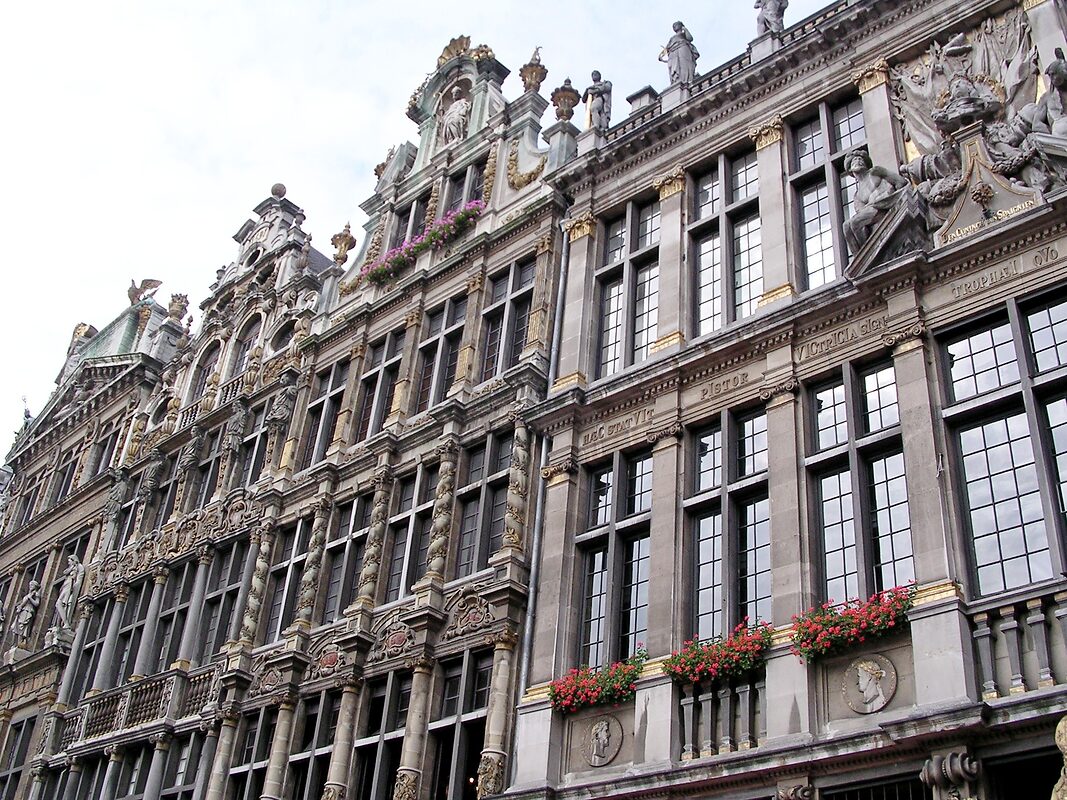
Morning: Grand Place at 8:30 a.m. before the tour buses. Walk the perimeter slowly; the guildhalls have gold sculptures that tell the story of Brussels in stone. The flower carpet returns in August 2026 — if you are here then, this square will be impossible to photograph without 3,000 other people in the frame.
Afternoon: Manneken Pis and the Comic Strip Route. The pissing boy is genuinely tiny, but his wardrobe of 900+ costumes is held at the Costume Museum nearby. From there, walk the Comic Strip Route: over 60 giant murals across the city center depicting Tintin, the Smurfs, and Lucky Luke. It turns a walk into a treasure hunt and costs nothing.
Evening: Delirium Café (Impasse de la Fidélité) — Guinness World Record holder for most beers available in one bar, with over 2,000 on the list. Order a Trappist and let the 17th-century cellar walls do the rest.
Day 2: Art and Architecture
Morning: Magritte Museum (Place Royale) — the largest single collection of surrealist works in the world, across three floors. Book online for €12. The same ticket complex includes the Old Masters wing with Bruegel and Rubens.
Afternoon: Horta Museum (Avenue Americaine) — Victor Horta’s own house, the masterwork of Brussels Art Nouveau. Limited timed entry; book a slot even with the Brussels Card. The interiors are so intact they feel like someone just stepped out.
Late afternoon: Mont des Arts — a park with gardens and fountains offering the best view over the city. The Royal Library and the Magritte Museum are both here.
Evening: Sablon District — antique dealers by day, terrace bars by night. The Grand Sablon square on a weekend morning has an antiques market worth browsing even if you are not buying.
Day 3: Modern Brussels and the Canal
Morning: Kanal-Centre Pompidou — Brussels’ first proper museum of modern and contemporary art, opening November 28, 2026 in a former Citroën garage by the canal. Ten exhibitions and over 350 works on loan from Paris. The rooftop restaurant has views back over the city.
Afternoon: Atomium — built for Expo 58 in 1958, still surreal 68 years on. 2026 marks the 20th anniversary of its 2004–2006 renovation, with three new digital art installations playing with light and reflection (Nimbus, Supply Chain, Rotonde). The viewing deck at the top gives 360-degree views of Brussels. Ticket €18.
Late afternoon: Mini-Europe at the foot of the Atomium — 350 miniature models of European landmarks in 1:25 scale. It sounds kitsch, and it is, but the detail is extraordinary. Best with children, or after two Belgian beers.
Evening: KAY 36 (Quai des péniches 36) — the new gourmet food hall in the Canal District. World cuisines, a sunny terrace facing the water, scheduled DJ sets, and a dog-friendly atmosphere. This is where Brussels goes after work.
Practical Tips
Buy the Brussels Card + STIB for 48 hours at €54. It breaks even at four museums and two transport days. The Magritte, Old Masters, Musical Instruments Museum, and Horta alone clear €52 in retail tickets. Skip the 24-hour tier — three museums in jet-lagged 24 hours is aggressive.
Do not eat on Rue des Bouchers between Grand Place and Manneken Pis. The menus are laminated, the staff are pushy, and the food is microwaved. Walk two streets east to Sainte-Catherine for better mussels at half the price.
The metro closes at midnight. After that, you are on night buses or taxis. Uber works; regular taxis do not always.
Sunday closures. Most shops close on Sunday. Supermarkets close at 8 p.m. and do not open on Sunday except in the EU quarter. Plan your food shopping around this.
Tipping. Service is included in Belgium. Rounding up the bill or leaving €1–2 per meal is generous. Do not tip 20 percent; it is not expected.
Language. Brussels is officially bilingual French and Dutch. Every sign is in both. Hotel staff and waiters almost always speak English. Trying bonjour or merci in French will get you a warmer response than starting in English.
Before You Go: Last-Minute Checks
- Check the Atomium’s 20th-anniversary (of the 2006 renovation) program before you go. The new digital art installations run throughout 2026; some are timed and require separate booking.
- Book Kanal-Centre Pompidou timed entry for November or later 2026 visits. The opening weekend will sell out.
- Confirm Brussels Card online before you land and activate it on your first museum visit, not at the airport. The activation clock starts on first scan.
- Check train strikes on the SNCB website. Belgian rail strikes happen with little warning and can strand you in the city.
Insider Tips
The Royal Greenhouses at Laeken open for two weeks only in late April and early May. Book tickets online a month in advance. The glasshouses contain rare plants and the view of the royal domain is worth the trip north of the city center.
The flea market at Jeu de Balle (Place du Jeu de Balle, Marolles) opens at 7 a.m. every morning. Go at 8 a.m. for the best browsing before the crowds arrive. You can find vintage cameras, old postcards, and furniture for prices that would be impossible in Paris or Amsterdam.
The best chocolate is not in the Grand Place shops. Look for small chocolatiers in Ixelles and around Place du Chatelain. The pralines are cheaper, fresher, and the chocolatiers will talk to you about tempering techniques if you ask.
Brussels has a Michelin-starred street food scene. The friteries around Sainte-Catherine and the Marché aux Puces have been praised by Belgian food critics for elevating the humble frite to something close to art.
The EU Parliament visitor center (Parlementarium) is free, interactive, and genuinely interesting even if you are not a politics nerd. The simulation of a plenary session is surprisingly gripping.
Etiquette & Culture
Greetings. A handshake is standard for strangers. Kissing on the cheek (three times, alternating sides) is common among friends. Do not initiate it unless invited.
Punctuality. Belgians are punctual. If you have a restaurant reservation or a museum ticket for a specific time, be on time. The 15-minute grace period common in southern Europe does not apply here.
Dining pace. Meals are unhurried. Waiters will not bring the bill until you ask. If you want the check, make eye contact and signal with your hand — do not wave aggressively.
Noise. Brussels is quieter than Paris or Amsterdam. Keep your voice down on public transit and in restaurants after 10 p.m.
Dress. Smart casual is the default. Brussels does not have a strict dress code, but you will feel underdressed if you wear athletic gear to dinner.
Queueing. Belgians queue properly. Do not cut in line, especially at the friterie or the bar. The person at the front of the line has been waiting longer than you have.
Useful Phrases
| French / Dutch | Pronunciation | English |
|---|---|---|
| Bonjour | bon-ZHOOR | Hello / Good morning |
| Merci | mer-SEE | Thank you |
| S’il vous plaît | sil voo PLAY | Please |
| Excusez-moi | ex-kew-ZAY mwah | Excuse me |
| L’addition, s’il vous plaît | la-dee-see-ohn | The bill, please |
| Een momentje, alstublieft | ain mo-MENT-yeh, als-too-BLEEFT | One moment, please |
| Dank je wel | dank yuh vel | Thank you very much |
| Spreekt u Engels? | spraakt u AN-gels? | Do you speak English? |
FAQs
Is Brussels safe? Yes. The city center is very safe, even at night. The northern neighborhoods around the canal have improved dramatically but still have pockets of trouble after dark. Use the same common sense you would in any European capital: watch your bag on the metro, avoid unlit streets late at night, and do not leave your phone on an outdoor café table.
How many days do I need? Three days is enough for the highlights: Grand Place, Magritte, Atomium, and a canal neighborhood. Four days lets you add a day trip to Bruges or Ghent, or the Royal Greenhouses if you are here in spring.
Is Brussels expensive? Moderate for Western Europe. A hostel dorm is €30–45, a mid-range hotel €90–150. A moules-frites dinner with a beer is €25–35. The Brussels Card saves money if you visit four or more museums in 48 hours.
Do I need to speak French or Dutch? No. English is universal in hotels, restaurants, and museums. But learning bonjour and merci goes a long way.
What is there to do at night? Brussels is not a party city, but it has excellent cocktail bars in Ixelles and Saint-Gilles, beer halls near the Grand Place, and late-night friteries. The Delirium Café stays open until 1 a.m. most nights. The comic-book bars around Place du Chatelain are also worth a visit.
When is the Flower Carpet? Every other August. The next one is August 2026, followed by 2028. The Grand Place will be covered in 500,000 begonias arranged in a giant floral tapestry. It is free and runs for three days.
Related Guides
- Bangkok: A 5-Day Urban Adventure Guide — for travelers who want another city that rewards transit mastery and street food
- Tokyo: Three Days in the World’s Most Booked Destination — for art, design, and neighborhood deep dives
- Laos: The Complete Slow-Travel Guide — for a European cultural capital paired with Southeast Asian immersion
The best trips do not just move you across a map. They change how you see the world. Use this guide to build your own story.
Start Planning Your Story