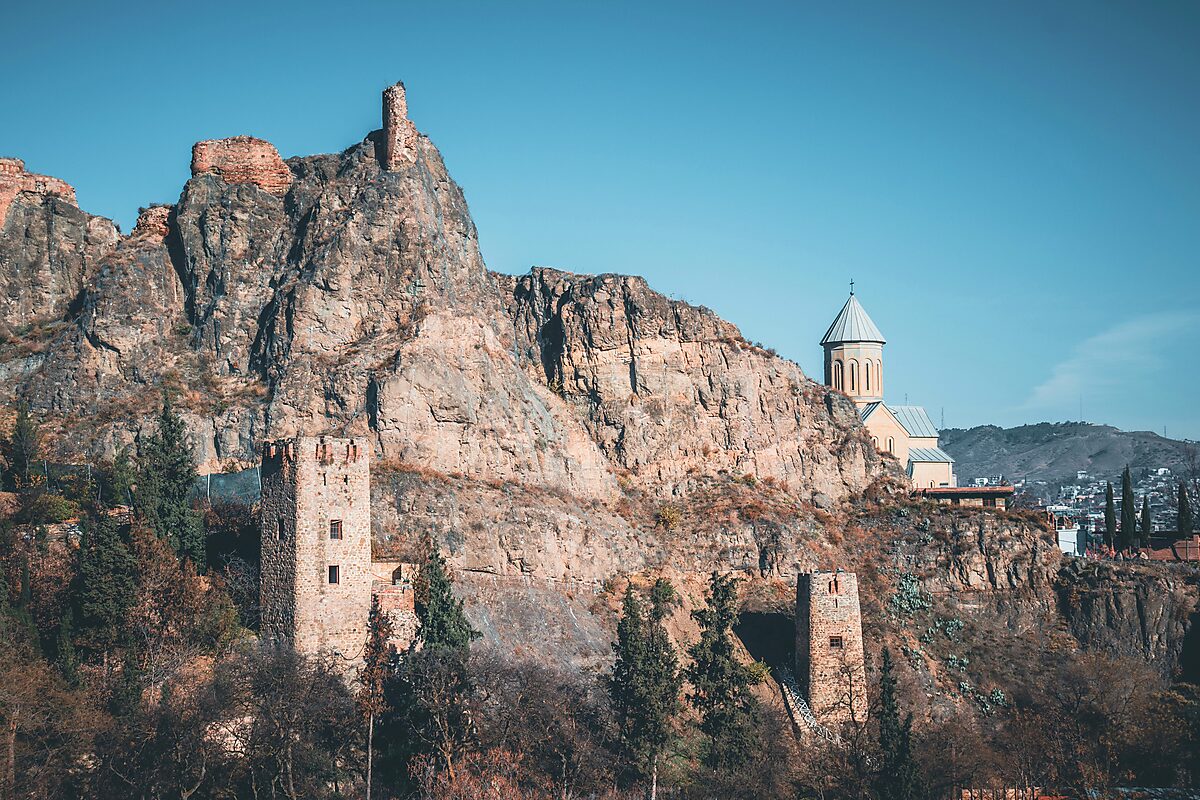
Tbilisi: The Complete 2026 Guide to Georgia's Wine-Soaked, Sulfur-Bath Capital
Tbilisi in 2026 is the #2 trending destination: 8,000-year winemaking, sulfur baths, a $150M airport, and food that rivals Lisbon at half the price.
Tbilisi: The Complete 2026 Guide to Georgia’s Wine-Soaked, Sulfur-Bath Capital
TL;DR
Tbilisi is the most interesting city in Europe in 2026 — a place where 8,000 years of winemaking culture meets a $150M airport expansion, where 38°C sulfur springs bubble beneath brick-domed bathhouses, and where a 4-course supra feast with homemade wine costs less than a single glass of Sancerre in Paris. The Old Town stacks carved wooden balconies, Soviet modernism, Art Nouveau, and neoclassical facades on top of each other in a streetscape that cannot be mistaken for anywhere else. The food scene has quietly become one of the best in Europe. The wine is its own category. Plan 3 days for the city proper, 5 if you add a day trip to Kazbegi or Kakheti, and add Mtskheta on the way back from Kazbegi for free. The 2026 caveats are real: protests on Rustaveli Avenue for 500+ consecutive days, mandatory travel insurance as of January 2026, and visa-free entry for 95+ nationalities (including US, UK, EU, Canada, Australia) but with a 30,000 GEL insurance floor. This guide covers the neighborhoods, baths, wine bars, day trips, and logistics that make a Tbilisi trip feel like time travel rather than tourism.
Who This Guide Is For
First-timers who want the iconic Old Town, a sulfur bath, and enough khinkali to need a nap. Wine travelers ready to taste amber qvevri wines and meet the winemakers. Solo travelers who want safe, walkable, and absurdly affordable. Foodies chasing a cuisine that fuses Persian, Turkish, Russian, and Caucasian into something genuinely its own. Day-trippers planning to add Kazbegi (Caucasus) or Kakheti (wine country). Anyone who has read about Tbilisi’s #2 Tripadvisor ranking in 2026 and wants to see it before the crowds fully arrive.
This guide assumes you are comfortable walking 10–15 km per day, willing to book one bathhouse and one wine experience in advance, and ready to treat Tbilisi as a base for the Caucasus rather than a single stop.
Quick Facts
| Question | Answer |
|---|---|
| Best time to go | April–May and September–October (warm, fewer crowds, October = Rtveli harvest) |
| Typical duration | 3 days for the city; 5 days with one day trip; 7+ for Kazbegi + Kakheti |
| Difficulty | Easy (city) to Moderate (Kazbegi hike) |
| Typical daily budget | USD $50–80 (mid-range), $30–50 (budget), $150+ (luxury) |
| Currency | Georgian Lari (GEL); 1 USD ≈ 2.60 GEL, 1 EUR ≈ 3.03 GEL (Sep 2026) |
| Visa | Visa-free 365 days for US/UK/EU/CA/AU/NZ/JP/KR; 95+ countries total |
| Insurance | MANDATORY from 1 Jan 2026 — minimum 30,000 GEL coverage, buy before departure |
| Best for | Wine, food, sulfur baths, Old Town walks, day trips to Caucasus, qvevri tastings |
| Avoid | Late July–August (35°C+ heat); Rustaveli protest zone after dark; unmarked street taxis |
Before You Go
Checklist
Documents & Money
- Passport (EU/UK citizens can use national ID card; 6 months validity is the safe rule for everyone else)
- Travel insurance certificate (mandatory as of 1 Jan 2026) — minimum 30,000 GEL coverage, English or Georgian, full stay. Buy at home or use Georgia’s e-cover portal (ecover.ge)
- Credit card (Visa/Mastercard widely accepted; Mir/Russian-issued cards do not work)
- USD or EUR cash for exchange — Tbilisi exchange offices beat the airport
- GEL cash for markets, marshrutkas, and tips (withdraw from TBC, Bank of Georgia, or Liberty ATMs; always decline DCC)
- For official tourism information, see Georgian National Tourism Administration
Apps to Download
- Bolt and Yandex Go for taxis (Bolt is dominant; Yandex Go is 10–20% cheaper and good at night)
- Google Maps with offline Tbilisi downloaded
- Google Translate with Georgian downloaded (most Georgians under 40 speak some English, but menus and signs benefit from translation)
- Visit Kakheti or WinExpo Georgia for wine region events
- Georgian Railways app if you plan intercity trips
Gear
- Comfortable walking shoes (cobblestones are unforgiving)
- Layers — even summer evenings can drop to 18°C, and winter brings snow
- Swimwear for the bathhouses (private rooms allow nude bathing if you prefer; public halls require swimwear)
- Modest clothing for church visits (covered shoulders, covered knees, women cover head in active churches)
- Sunscreen and a hat for Old Town walks in summer
- Reusable water bottle (Tbilisi tap water is drinkable; refill stations at hotels and cafés)
Mandatory Insurance (Critical 2026 Change)
Effective 1 January 2026, all foreign visitors must hold health and accident insurance covering their full stay, with minimum 30,000 GEL coverage. Airlines are now checking at check-in (denied boardings have been reported), and roughly 20% of arrivals are checked at TBS airport.
- US cost: $45–110 for a 2-week policy from World Nomads, SafetyWing, or Allianz
- Buy before departure and carry both digital and printed proof
- Exemptions exist for diplomats and Georgian residence-permit holders only
- Land border crossings (especially via Armenia) check less frequently, but the same rule applies
A 2-week policy that meets the 30,000 GEL floor costs roughly the same as one glass of wine in a Tbilisi wine bar. Do not skip it.
Getting There
Tbilisi International Airport (TBS) sits 17 km southeast of the city centre, with 134 scheduled routes to 98 destinations and 65 airlines in 2026. A $150M terminal expansion launched in July 2026 will double capacity from 5M to 10M passengers by 2028. New 2026 routes include TBS–Beijing (Air China), TBS–Copenhagen (Norwegian), TBS–Madrid (Iberia), and TBS–Cologne (Eurowings).
There are no direct flights from the US in 2026. The best transatlantic connections route through Istanbul, Doha, Dubai, London, Frankfurt, Munich, or Paris.
| Option | Cost (2026) | Time | Notes |
|---|---|---|---|
| Bus 337 (airport bus) | 1 GEL (tap card) | 40–60 min | Daily, daytime hours (~07:00–23:00), every 15–20 min |
| Bolt / Yandex Go | 25–45 GEL | 25–35 min | Use the app; never accept unmarked street taxis |
| Pre-booked private transfer | 50–70 GEL | 20–30 min | Book via GoTrip.ge or Welcome Pickups |
| Official airport taxi booth | Fixed by zone | 25–35 min | Pay at the booth inside, not in the car |
The classic airport trap: unmarked taxi drivers at arrivals will quote 50–100 GEL for a 25-GEL trip. Open the Bolt app before you leave baggage claim. The drivers inside the terminal are fine if you use the booth.
Where to Stay
Old Town (Abanotubani + Sololaki) — the iconic core. Walking distance to the sulfur baths, Narikala Fortress, the Bridge of Peace, and most wine bars. The Stamba (in a converted Soviet publishing house) and Telegraph Hotel (Neri&Hu design, opened 2026) are the standout luxury options. Mid-range boutique hotels cluster around Erekle II Street; budget guesthouses sit up the hill toward Freedom Square.
Freedom Square / Rustaveli Avenue — central and walkable. The Marriott, Radisson Blu, and Paragraph Freedom Square (a strong Marriott points redemption) anchor the chain hotels. Closer to museums and the main east-west axis. Note: the parliament zone on Rustaveli is the site of ongoing protests; the avenue itself is fine, but the immediate building entrances are best avoided after dark.
Vera / Vake — the leafy western neighbourhoods. Local cafés, art galleries, and a younger crowd. Quieter at night. Slightly further from Old Town (15–20 min by Bolt, 5–10 GEL) but closer to the Vera natural-wine bar cluster.
Marjanishvili — the trendy industrial zone. Fabrika (a Soviet sewing factory turned hostel, courtyard of bars, and design shops) anchors the social scene. Cheaper accommodation and the best late-night food.
Chughureti — emerging neighbourhood west of Marjanishvili, where the new Tbilisi Digital Space art museum and a wave of small wine bars have opened. Walkable to Fabrika.
| Budget | Nightly cost (USD) | What you get |
|---|---|---|
| Budget | $25–50 | Guesthouse room, shared kitchen, local neighbourhood |
| Mid-range | $60–120 | Boutique hotel, private bathroom, Old Town or Vera location |
| Splurge | $150–300 | Telegraph, Stamba, Rooms Hotel Tbilisi, or Marriott brands |
What to Eat
Tbilisi’s food scene is one of the great underrated cuisines of Europe, sitting at the intersection of Persian, Turkish, Russian, and Caucasian food cultures with a distinct identity all its own. The defining structures are the supra (a long ritualised feast with toasts in fixed sequence: Georgia, ancestors, parents, friends, women, children, peace, the visitor, hosted by a tamada or toastmaster), khinkali (soup-filled dumplings, gathered at the top, the cap left uneaten — counting your caps is the end-of-meal joke), khachapuri (cheese bread, in regional variants), and qvevri wine.
Dishes to Order
- Khinkali — the soup dumpling. 1–2 GEL each at a working khinkali house. Order 8–10 per person for a meal. Twist the top before eating to release the broth; leave the cap on your plate.
- Adjarian khachapuri — the boat-shaped bread filled with cheese and topped with a raw egg yolk and butter. Stir vigorously before eating. Iconic at every Old Town café.
- Imeretian khachapuri — flat cheese bread, the more restrained cousin.
- Lobiani — bean-stuffed bread, the essential Georgian breakfast.
- Pkhali — vegetable and walnut pâté, served cold, perfect with bread and wine.
- Badrijani — eggplant rolls stuffed with walnut paste and pomegranate.
- Mtsvadi — pork or veal skewers grilled over vine cuttings, the Caucasian barbecue.
- Satsivi — turkey or chicken in a cold walnut sauce, served at room temperature.
- Churchkhela — the candle-shaped walnut-and-grape-juice snack, the original Georgian energy bar.
Where to Eat
- Khinkali Bar N1 — reliable khinkali and classic starters. Multiple locations. Friendly, mid-range, English menu.
- Barbarestan — historic-home dining, set in a 19th-century house, serving updated Georgian recipes from the 1914 cookbook by Barbare Eristavi-Jorjadze. Worth the visit for the architecture alone.
- Kneina — Michelin-quality food at local prices, in a historic home near the baths. Get the homemade wine, the lemonade, and whatever appeals.
- Shemoikhede Genatsvale — Old Town classic, strong supra experience, traditional recipes.
- Fabrika courtyard — the industrial food court, multiple vendors, late hours. The social hub for nomads and younger travelers.
- Café Littera — in the garden of the House of Writers, a literary-haunting setting, exclusively Georgian wine list, daily-changing menu.
- Azarpesha — opens at 9 p.m., best after midnight, the late-night table of strangers who will not be strangers by the end.
Wine (the part that matters most)
Georgia claims 8,000 years of continuous winemaking — the qvevri method (fermenting whole-cluster grapes in buried clay amphorae) is unique to the South Caucasus and was inscribed on UNESCO’s Intangible Cultural Heritage list in 2013. The skin contact produces amber wines that drive the global natural-wine movement. The two grapes that matter most: Rkatsiteli for whites (amber, tannic, earthy), Saperavi for reds (deeply colored, high acid, ages for decades).
- Vino Underground (Galaktion Tabidze 15) — the original natural-wine bar, opened 2012, co-operatively owned by 10–11 small qvevri producers. The benchmark.
- G.Vino (Erekle II Street) — Old Town, slightly more polished, well-curated by-the-glass selection.
- 8000 Vintages (Rustaveli Avenue) — wine shop and bar, eight-wine flights by region, the longest by-the-glass list in the centre.
- Baasi Wine Bar & Shop — newer 2026 entry, focused on small producers.
- Atoneli Wine Window — Tbilisi’s first, opened spring 2025, a Florence-inspired buchetta pouring qvevri by the glass for 8 GEL. The viral moment of 2025–2026.
The supra experience: if you want the full ritualised feast with a tamada, book a supra dinner with Real Georgia Supra (Keto, Keti, or another host). Expect 4 hours, 8 courses, unlimited wine, and 10–20 toasts. From 200 GEL/person.
Day-by-Day Itinerary
Day 1: Old Town Foundations
Morning: Land at TBS, take Bus 337 (1 GEL) or a Bolt to your hotel in Old Town or Vera. Drop bags, walk 10 minutes to Freedom Square, then start south on Pushkin Street to the Bridge of Peace (the 156m glass-and-steel pedestrian bridge over the Mtkvari, lit up at night). Cross and climb the steps to Narikala Fortress (4th century, ruined and rebuilt nine times). The view from the top: the Old Town below, the Bridge of Peace, and the sulfur bath domes in Abanotubani. Take the Rike–Narikala cable car down if your knees protest (2.50 GEL).
Afternoon: Walk down into Abanotubani — the sulfur bath district, identifiable by its half-buried brick domes and the blue-tiled facade of Chreli Abano (the most photographed bath in the city). Book a private room here for the evening session (1.5–2 hours, 80–130 GEL). Lunch at Khinkali Bar N1 on Erekle II Street. After lunch, walk through the Old Town: Sioni Cathedral (6th century, the cross of St. Nino on display), Anchiskhati Basilica (6th century, the oldest surviving church in Tbilisi), Shardeni Street (the bar-and-restaurant strip, quiet in the afternoon, loud after 8 p.m.).
Evening: Sulfur bath at Chreli Abano or Gulo’s Thermal Spa. After: dinner at Azarpesha (if you can handle late hours) or Kneina for a more refined experience. Walk the Old Town after dark — the bathhouse domes are lit, the Bridge of Peace glows, and the city earns its name (tbili = warm).
Day 2: Wine and Art
Morning: Coffee and lobiani at any neighbourhood bakery (7 GEL for the full breakfast). Walk Rustaveli Avenue north to the Georgian National Museum (40 GEL, opened 2026 with refreshed galleries). Highlights: the Archaeology Prehistory Hall (qvevri through the ages), the Gold Treasury, and the Soviet Occupation展厅. Two to three hours is enough.
Afternoon: Lunch at Café Littera in the House of Writers garden. Cross the Mtkvari to visit the Tbilisi Digital Space (Caucasus’s first digital art museum, opened 2026) and the Rezo Gabriadze Marionette Theatre (his clock tower leans intentionally; book tickets for an evening show if you can). Late afternoon: walk the Mtkvari riverfront to the Dry Bridge Market (weekend flea market, Soviet memorabilia, antique jewelry, hand-painted scarves).
Evening: Wine bar crawl. Start at 8000 Vintages for the eight-wine flight, move to G.Vino for a glass with the Old Town view, end at Vino Underground for a single producer’s qvevri you’ll never find in your home wine shop. Dinner at a working khinkali house — count your caps, leave the stems on the plate, drink more than you planned.
Day 3: Baths, Markets, and Mtatsminda
Morning: Walk the Old Town’s eastern edge to the Sioni Cathedral and the Armenian Pantheon (where the writer Ilia Chavchavadze and the Soviet dissident Merab Kostava are buried). Climb to the Mother of Georgia statue (the 20m aluminum woman holding a sword in one hand and a wine cup in the other — she welcomes friends and repels enemies). Take the Mtatsminda funicular up to Mtatsminda Park (12 GEL, panoramic views of the entire city). Lunch at the funicular-station café, not the amusement-park stalls.
Afternoon: Descend via the Pantheon (free entry until 18:00), then visit the Open Air Ethnography Museum (Norfolk-style village reproductions from across Georgia, 15 GEL). Late afternoon: a second bath session at a different bathhouse to compare the cultures. Bathhouse No. 5 offers the cheapest public bath (10 GEL) — bring soap, shampoo, towel, and flip-flops.
Evening: Tbilisoba (Tbilisi city festival) falls on 3–4 October 2026 and transforms the Old Town. If your visit overlaps, attend: 3.1 million GEL budget, free, citywide. If not, the Fabrika courtyard offers the best mid-week night out — food trucks, wine bars, and the nomad/expat crowd.
Day 4: Day Trip to Mtskheta and Kazbegi (the Caucasus)
Morning: Depart at 7:30 a.m. (pre-booked driver or shared tour, ~350 GEL/car for a private day). The Georgian Military Highway is one of the great road trips in the Caucasus. First stop: Jvari Monastery (6th century, on a hilltop above the Mtkvari/Aragvi confluence) — the view alone justifies the trip. Continue to Mtskheta for Svetitskhoveli Cathedral (11th century, UNESCO, burial site of Christ’s Robe, the spiritual heart of Georgia). Entry is free; dress modestly (covered shoulders and knees, women cover head).
Midday: Continue north through the Cross Pass to Ananuri Fortress (17th century, on the Zhinvali Reservoir) and onward to Stepantsminda (Kazbegi) — a 3-hour drive total. Lunch at Rooms Hotel Kazbegi or a working guesthouse.
Afternoon: Hike 1.5–2 hours to Gergeti Trinity Church (14th century, on a shoulder below Mt. Kazbek at 5,050m). The walk is steep but the silhouette of the church against the mountain is the defining Caucasus image. If the hike is too much, take a local 4×4 shuttle (~25–30 GEL per seat). Return to Tbilisi by 8 p.m.
Day 5: Kakheti (Wine Country)
Morning: Depart at 8:30 a.m. for Sighnaghi (110 km east, 1.5–2 hours by car). The hilltop “City of Love” is wrapped in 4.5 km of 18th-century fortress walls, with views across the Alazani Valley to the Greater Caucasus. Walk the walls, visit the Bodbe Monastery (tomb of St. Nino, 4th century, a 2km walk from town).
Afternoon: Pheasant’s Tears winery in Sighnaghi for a qvevri tasting (8 wines, 30 GEL, 90 minutes). Continue to Telavi for a supra lunch at a family winery (60–100 GEL including tasting, food, and as much wine as the host can pour). In late September and October, the Rtveli grape harvest is in full swing — participate in the marani (wine cellar) work if timing allows.
Evening: Return to Tbilisi by 7 p.m. If you have the energy, end the trip at Stamba for one last glass of Saperavi and a final look at the Old Town from across the river.
Skip
- Visiting in late July or August without planning for 35°C+ heat: the Old Town has limited shade, and the city loses 30% of its outdoor appeal between 14:00 and 18:00. Move indoors — the National Museum, the State Silk Museum, and the Tbilisi Digital Space all have air conditioning and content. Save outdoor walking for early morning and after 6 p.m.
- Trusting unmarked street taxis: drivers will quote 50–100 GEL for a 25-GEL trip. Open the Bolt app before you leave the arrivals hall. The drivers inside the terminal using the official booth are fine.
- Skipping the bathhouse reservation on weekends: Chreli Abano’s private rooms fill up 1–2 days in advance from May to October. If the website’s SMS verification fails, send a WhatsApp message to the number on the official site — this is a documented workaround.
- Approaching the Rustaveli protest zone after dark: the anti-government protests have run for 500+ consecutive days as of mid-2026 and are concentrated around parliament in the evenings. Visitors are not targets, but the immediate area is best avoided after dark for your own navigation comfort. See the US State Dept Georgia for current guidance.
- Forgetting the mandatory insurance: the airlines are checking at check-in, and denied boardings have been reported. A 2-week policy that meets the 30,000 GEL floor costs $45–110 — buy it before you leave home.
- Paying the DCC on ATM withdrawals: when an ATM asks whether to charge you in your home currency or in GEL, always choose GEL. The DCC markup is 3–7% on top of the local bank’s fees.
- Skipping the supra experience: even a short 2-hour supra with a host at a smaller restaurant gives you the tamada toasts, the polyphonic singing, and the slow ritual that defines Georgian hospitality. Book one.
- Leaving cash at home: while 90% of Tbilisi takes cards, the markets, marshrutkas, and some family restaurants in the regions are still cash-only. Withdraw 200–500 GEL at a time from a major-bank ATM and keep small bills for tips and rural stops.
What $70 a Day Actually Buys
Mid-range day: Old Town guesthouse ($35), breakfast with lobiani and coffee ($3), National Museum entry ($15), cable car up to Narikala ($1), lunch at a working khinkali house with a beer ($8), 2-hour private sulfur bath at Chreli Abano with a kisa scrub ($30), wine flight at 8000 Vintages ($10), dinner at Shemoikhede Genatsvale with a bottle of qvevri Saperavi ($18). Roughly $120 total per person for the full Tbilisi immersion — half what a comparable day in Lisbon would cost. Drop the bathhouse to the public 5-GEL option and you’re at $90. Skip the museum and the wine flight and you can do a comfortable Tbilisi day for $60.
One Thing You Can’t Skip
Sunset at Narikala Fortress after walking up from the Bridge of Peace. The fortress has been ruined and rebuilt nine times since the 4th century and wears its damage with the equanimity of something that knows it will still be here. The view from the top is the entire city in one frame: the Mtkvari River snaking brown and fast below, the onion domes of Metekhi Church on the opposite cliff, the Bridge of Peace glinting like a fish spine across the water, and the sulfur-bath domes of Abanotubani at your feet. Stay until the light drops and the city lights come on. Then walk down into the bath district for dinner and a glass of qvevri wine. This is the moment Tbilisi sells itself.
Useful Phrases
Georgian (Kartuli) is a language isolate with its own alphabet — do not expect Russian to help. Most Georgians under 40 speak some English, but a few words go a long way.
| English | Georgian | Pronunciation |
|---|---|---|
| Hello | გამარჯობა | ga-mar-jo-ba |
| Thank you | მადლობა | mad-lo-ba |
| Yes / No | კი / არა | kee / a-ra |
| Cheers | გაუმარჯოს | ga-u-mar-jos |
| Delicious | გემრიელია | gem-ri-e-li-a |
| Please / You’re welcome | გთხოვთ / გმადლობთ | gt-khovt / gmad-lobt |
| How much? | რა ღირს? | ra ghirs? |
| To your health! | ჯანმრთელობაზე! | jan-mr-the-lo-ba-ze! |
| Goodbye | ნახვამდის | nakh-vam-dis |
The supra toast vocabulary is its own world: Gaumarjos (cheers) is the universal opener, but each toast has a name. The tamada announces it; you respond with the same word, drink, and stay silent until the next.
FAQs
Is Tbilisi safe in 2026? Yes, for normal tourism. Tbilisi ranks 49th out of ~380 cities on the 2026 Numbeo Safety Index. The only caveats: avoid the immediate parliament/Rustaveli zone during evening protests, never visit Abkhazia or South Ossetia (Russian-occupied, advised against by US/UK/CA/AU governments), and ignore street touts offering “free” tours. Sources: US State Dept Georgia · Smartraveller Georgia
Do I need a visa for Georgia? For citizens of 95+ countries — including the US, UK, EU, Canada, Australia, New Zealand, Japan, South Korea — no visa is required for stays up to 365 days. Your passport should be valid for the duration of your stay. EU/UK citizens can enter on a national ID card. Sources: GNTE · US State Dept Georgia
Do I need travel insurance? Yes, mandatory as of 1 January 2026. Minimum 30,000 GEL coverage, English or Georgian, covering your full stay. Buy before departure (the airlines check at check-in). A 2-week policy costs $45–110 from World Nomads, SafetyWing, or Allianz.
How many days do I need in Tbilisi? Three full days covers the city highlights. Five days lets you add a day trip to Kazbegi (Caucasus mountains) or Kakheti (wine country). Seven days is the unhurried version with both day trips plus Mtskheta.
Is Tbilisi affordable? Yes. A comfortable mid-range day in the Old Town (boutique hotel, restaurant meals, one wine bar, one museum, taxi rides) costs $70–120 per person. Budget travel with guesthouses and bakeries can hit $30–50 per day. The same quality of food, wine, and architecture in Lisbon would cost roughly twice as much.
When is the best time to visit? April–May and September–October. October is the strongest single month for cultural depth (Rtveli harvest + Tbilisoba). July–August is hot (35°C+). Winter (December–February) is atmospheric but cold; some mountain day trips are snow-restricted.
Can I visit Abkhazia or South Ossetia? No. Both regions are Russian-occupied, and the US, UK, Canadian, and Australian governments advise against all travel. Crossing the occupation line from the Georgian side is illegal under Georgian law and dangerous under any measure.
What about the protests? Anti-government protests have run for 500+ consecutive days on Rustaveli Avenue since November 2024, triggered by the government’s decision to suspend EU accession talks. The protests are pro-European and largely peaceful; demonstrations are concentrated around parliament in the evenings. Visitors are not targets, and outside the immediate parliament zone, no itinerary changes are needed. Avoid the building after dark and check local news before evening plans in central Tbilisi.
What is qvevri wine and why is it special? Qvevri is a clay amphora, egg-shaped and buried underground, used to ferment whole-cluster grapes (skins, stems, seeds, and juice together) for 6 months or more. The method is unique to the South Caucasus and has been continuously practised for ~8,000 years. UNESCO inscribed it as Intangible Cultural Heritage in 2013. The skin contact produces the amber wines (orange wines) that drove the global natural-wine movement.
How do I get from the airport to the city? Bus 337 (1 GEL, ~40–60 min, ~07:00–23:00), Bolt or Yandex Go (25–45 GEL, 25–35 min), or a pre-booked private transfer (50–70 GEL). Avoid unmarked street taxis at arrivals.
Related Guides
- Lisbon, Portugal — a comparable affordable European capital with strong food, wine, and day-trip culture.
- Oaxaca, Mexico — another city with a deep food-and-drink tradition (mezcal, mole) at a similar price point.
- Kyoto, Japan — for the cultural immersion angle: ancient capital, slow travel, neighbourhood-by-neighbourhood depth.
The best trips do not just move you across a map. They change how you see the world. Use this guide to build your own story.
Start Planning Your Story